Who Is Mr Jennings in Sense and Sensibility Family Tree
 Championship folio from the original 1811 edition | |
| Author | Jane Austen |
|---|---|
| Country | United Kingdom |
| Language | English language |
| Genre | Romance novel |
| Publisher | Thomas Egerton, War machine Library (Whitehall, London) |
| Publication date | 1811 |
| OCLC | 44961362 |
| Followed by | Pride and Prejudice |
| Text | Sense and Sensibility at Wikisource |
Sense and Sensibility is a novel by Jane Austen, published in 1811. Information technology was published anonymously; By A Lady appears on the title folio where the author's proper noun might have been. It tells the story of the Dashwood sisters, Elinor (age xix) and Marianne (age xvi½) every bit they come of age. They have an older half-brother, John, and a younger sister, Margaret (age 13).
The novel follows the three Dashwood sisters as they must move with their widowed mother from the estate on which they grew up, Norland Park. Because Norland is passed down to John, the product of Mr. Dashwood's first marriage, and his immature son, the four Dashwood women need to look for a new home. They take the opportunity to rent a modest home, Barton Cottage, on the belongings of a distant relative, Sir John Middleton. There Elinor and Marianne experience dearest, romance, and heartbreak. The novel is set in Due south West England, London, and Sussex, probably between 1792 and 1797.[1]
The novel, which sold out its get-go print run of 750 copies in the center of 1813, marked a success for its author. Information technology had a 2d print run later that year. Information technology was the first Austen title to be republished in England after her death, and the first illustrated Austen book produced in United kingdom, in Richard Bentley'south Standard Novels series of 1833.[ii] The novel has been in continuous publication since 1811, and has many times been illustrated, excerpted, abridged, and adapted for stage, film, and television.[3]
Plot summary [edit]
Henry Dashwood, his 2nd wife, and their three daughters alive for many years with Henry'due south wealthy bachelor uncle at Norland Park, a large state estate in Sussex. That uncle decides, in late life, to will the utilize and income only of his property first to Henry, and so to Henry'south first son (past his first spousal relationship) John Dashwood, so that the belongings should laissez passer intact to John'south four-year-former son Harry. The uncle dies, only Henry lives just a yr after that and he is unable in such short time to salve enough money for the future security of his wife Mrs Dashwood, and their daughters, Elinor, Marianne, and Margaret, who are left only a small income. On his deathbed, Mr Henry Dashwood extracts a hope from his son John to accept care of his one-half-sisters. But before Henry is long in the grave, John'southward greedy married woman, Fanny, persuades her hubby to renege on the hope, appealing to his concerns about diminishing his own son Harry'south inheritance, despite the fact that John is already independently wealthy thank you to both his inheritance from his mother and his wife'due south dowry. Henry Dashwood's love for his second family is also used past Fanny to arouse her hubby's jealousy, and persuade him not to help his sisters financially.
John and Fanny immediately move in every bit the new owners of Norland, with the Dashwood women are treated as unwelcome guests past a spiteful Fanny. Mrs Dashwood seeks somewhere else to alive. In the meantime, Fanny's brother, Edward Ferrars, visits Norland and is attracted to Elinor. Fanny disapproves of their budding romance, and offends Mrs Dashwood by implying that Elinor must exist motivated past his expectations of coming into coin.
Mrs Dashwood moves her family to Barton Cottage in Devonshire, nearly the home of her cousin, Sir John Middleton. Their new abode is modest, but they are warmly received by Sir John and welcomed into local society, meeting his married woman, Lady Middleton, his mother-in-police, the garrulous just well-meaning Mrs Jennings, and his friend, Colonel Brandon. Colonel Brandon is attracted to Marianne, and Mrs Jennings teases them near information technology. Marianne is not pleased, as she considers the thirty-five-yr-old Colonel Brandon an old available, incapable of falling in beloved or inspiring love in anyone.
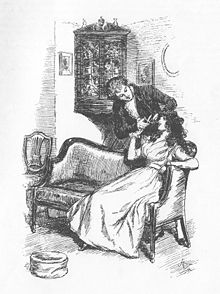
A 19th-century illustration by Hugh Thomson showing Willoughby cut a lock of Marianne's pilus
While out for a walk, Marianne gets caught in the rain, slips, and sprains her ankle. The dashing John Willoughby sees the blow and assists her, picking her up and conveying her back to her home. After this, Marianne chop-chop comes to admire his good looks and his like tastes in poesy, music, art, and love. His attentions, and Marianne's behaviour, lead Elinor and Mrs Dashwood to doubtable that the couple are secretly engaged. Elinor cautions Marianne against her unguarded behave, but Marianne refuses to check her emotions. Willoughby engages in several intimate activities with Marianne, including taking her to see the dwelling he expects to inherit one day and obtaining a lock of her hair. When the announcement of 1, seems imminent, Willoughby instead informs the Dashwoods that his aunt, upon whom he is financially dependent due to his debts, is sending him to London on business concern, indefinitely. Marianne is distraught and abandons herself to her sorrow.
Edward Ferrars pays a brusque visit to Barton Cottage, but seems unhappy. Elinor fears that he no longer has feelings for her, but she will non bear witness her heartache. After Edward departs, sisters Anne and Lucy Steele, vulgar cousins of Mrs. Jennings, come to stay at Barton Park. Lucy informs Elinor in confidence of her cloak-and-dagger four-year engagement to Edward Ferrars that started when he was studying with her uncle, and she displays proof of their intimacy. Elinor realises that Lucy'south visit and revelations are the result of her jealousy and cunning calculation, and it helps Elinor to empathise Edward's contempo sadness and behaviour towards her. She acquits Edward of blame and pities him for existence held to a loveless engagement to Lucy by his sense of honour.
Elinor and Marianne accompany Mrs Jennings to London. On arriving, Marianne rashly writes several personal letters to Willoughby, which go unanswered. When they run across past hazard at a trip the light fantastic, Willoughby is with another adult female. He greets Marianne reluctantly and coldly, to her extreme distress. She leaves the party completely distraught. Before long Marianne receives a curt letter of the alphabet enclosing their former correspondence and beloved tokens, including the lock of her hair. Willoughby is revealed to exist engaged to a young lady, Miss Grayness, who has a large fortune. Marianne is devastated. After Elinor reads the letter, Marianne admits to Elinor that she and Willoughby were never engaged. She behaved as if they were because she knew she loved him and idea that he loved her.
As Marianne grieves, Colonel Brandon visits and reveals to Elinor that Willoughby seduced, impregnated, then abandoned Brandon's young ward, Miss Eliza Williams. Willoughby's aunt subsequently disinherited him, and so, in great personal debt, he chose to marry Miss Grey for her money. Eliza is the illegitimate daughter of Brandon's commencement love, as well called Eliza, a young adult female who was his begetter'southward ward and an heiress. She was forced into an unhappy marriage to Brandon'southward elder brother, in club to shore upwardly the family's finances, and that marriage concluded in scandal and divorce while Brandon was abroad with the Army. After Colonel Brandon's father and blood brother died, he inherited the family estate and returned to discover Eliza dying in a pauper'due south abode, so Brandon took accuse of raising her immature girl. Brandon tells Elinor that Marianne strongly reminds him of the elderberry Eliza for her sincerity and sweet impulsiveness. Brandon removed the younger Eliza to the country, and reveals to Elinor all of these details in the hope that Marianne could get some alleviation in discovering Willoughby's truthful character.
Meanwhile, the Steele sisters have come up to London. Afterward a brief associate, they are asked to stay at John and Fanny Dashwood's London house. Lucy sees the invitation as a personal compliment, rather than what it is: a slight to Elinor and Marianne who, being family, should accept received such an invitation first. Too talkative, Anne Steele betrays to Fanny Lucy's secret engagement to Edward Ferrars. As a result, the sisters are turned out of the house, and Edward is ordered by his wealthy mother to suspension off the engagement on hurting of disinheritance. Edward, nonetheless sensitive of the dishonour of a broken appointment and how it would reflect poorly on Lucy Steele, refuses to comply. He is immediately disinherited in favour of his brother, Robert, which gains Edward respect for his conduct and sympathy from Elinor and Marianne. Colonel Brandon shows his adoration past offer Edward the clerical living of the Delaford parsonage, and then to enable him to marry Lucy later he is ordained.
Mrs Jennings takes Elinor and Marianne to the country to visit her second girl, Mrs. Charlotte Palmer, at her husband'southward manor, Cleveland, on their mode back to their habitation in Devonshire. Marianne, all the same in misery over Willoughby'due south marriage, goes walking in the rain and becomes dangerously ill. She is diagnosed with putrid fever, and it is believed that her life is in danger. Elinor writes to Mrs. Dashwood to explain the gravity of the situation, and Colonel Brandon volunteers to go and bring Marianne'south mother to Cleveland to be with her. In the night, Willoughby arrives and reveals to Elinor that his love for Marianne was 18-carat and that losing her has made him miserable. He elicits Elinor's compassion because his choice has made him unhappy, but she is disgusted by the callous style in which he talks of Miss Williams and his own wife. He besides reveals that his aunt said she would have forgiven him if he married Miss Williams simply that he had refused.
Marianne recovers from her disease, and Elinor tells her of Willoughby'due south visit. Marianne realizes she could never have been happy with Willoughby's immoral, erratic, and inconsiderate ways. She values Elinor's more than moderated conduct with Edward and resolves to model herself later on her courage and good sense. Edward later on arrives and reveals that, after his disinheritance, Lucy jilted him in favour of his now wealthy younger brother, Robert. Elinor is overjoyed. Edward and Elinor ally, and afterward Marianne marries Colonel Brandon, having gradually come to dear him. The ii couples alive as neighbours, with sisters and husbands in harmony with each other. Willoughby considers Marianne as his ideal but the narrator tells the reader not to suppose that he was never happy.
Characters [edit]
- Elinor Dashwood – the sensible and reserved eldest daughter of Mr and Mrs Henry Dashwood. She represents the "sense" half of Austen's title, although not exclusively. She is 19 years old at the commencement of the book. She becomes attached to Edward Ferrars, the brother-in-constabulary of her elderberry half-brother, John. She sympathetically befriends Colonel Brandon, Marianne's long-suffering admirer and eventual husband. E'er feeling a keen sense of responsibleness to her family and friends, she places their welfare and interests above her own and suppresses her own stiff emotions in a way that leads others to call up she is indifferent or cold-hearted. E'er honourable, she feels she must not reveal Lucy Steele'southward cloak-and-dagger date to Edward, fifty-fifty though it causes her neat suffering. While the book's narrative mode is 3rd person all-seeing, it is Elinor's viewpoint that is primarily reflected. Thus, the description of most of the novel's characters and events reflects Elinor's thoughts and insights.
- Marianne Dashwood – the romantically inclined and eagerly expressive second daughter of Mr and Mrs Henry Dashwood. Her emotional excesses identify her every bit the "sensibility" of the book'southward title, although once more, not exclusively (at the time, "sensibility" meant driven primarily by 1's emotions). She is 16 years sometime at the beginning of the book. She is the object of the attentions of Colonel Brandon and Mr Willoughby. She is attracted to young, handsome, romantically spirited Willoughby and does not think much of the older, more than reserved Colonel Brandon. Marianne undergoes the nigh development within the book, learning that her sensibilities accept been selfish. She decides that her behave should exist more like that of her elder sis, Elinor.
- Edward Ferrars – the elder of Fanny Dashwood's two brothers. He forms an zipper to Elinor Dashwood. Years earlier coming together the Dashwoods, Ferrars proposed to Lucy Steele, the niece of his tutor. The engagement has been kept secret owing to the expectation that Ferrars' family would object to his marrying Miss Steele, who has no fortune. He is disowned by his mother on discovery of the engagement after refusing, out of a sense of duty, to requite it up.
- John Willoughby – a philandering nephew of a neighbour of the Middletons, a dashing figure who charms Marianne and shares her artistic and cultural sensibilities. Information technology is generally presumed by many of their common acquaintances that he is engaged to ally Marianne (partly due to her own overly familiar actions); yet, he abruptly ends his associate with the family and leaves just when an engagement with Marianne seems imminent. It is later on revealed that he becomes engaged to the wealthy Sophia Gray because of the ending of fiscal support from his aunt. He is besides contrasted by Austen as being "a man resembling 'the hero of a favourite story'".[4]
- Colonel Brandon – a close friend of Sir John Middleton. He is 35 years onetime at the beginning of the book. He falls in love with Marianne at first sight, as she reminds him of his begetter's ward, Eliza, whom he loved when he was young. He was prevented from marrying Eliza because his begetter was determined that she should marry Brandon'due south older brother. Brandon was sent into the military machine away to be away from her, and while he was gone, Eliza suffered numerous misfortunes, partly as a result of her unhappy marriage. She finally died penniless and disgraced, and with a "natural" (i.east., extramarital) girl, also named Eliza, who becomes the ward of the Colonel. He is a very honourable friend to the Dashwoods, especially Elinor, and offers Edward Ferrars a living after Edward is disowned by his female parent.
- Henry Dashwood – a wealthy admirer who dies at the start of the story. The terms on which he inherited his manor and his ain death shortly later on prevent him from leaving anything of substance to his 2nd married woman and their children. He extracts a promise from John, his son past his commencement wife, to expect after (pregnant ensure the financial security of) his second wife and their three daughters.
- Mrs Dashwood – this name always refers to the second wife of Henry Dashwood. She is left in difficult financial straits by the death of her married man. She is forty years old at the offset of the book. Much like her daughter Marianne, she is very emotive and often makes poor decisions based on emotion rather than reason.
- Margaret Dashwood – the youngest girl of Mr and Mrs Henry Dashwood. She is thirteen at the starting time of the book. She is also romantic and good-tempered merely not expected to be as clever every bit her sisters when she grows older.
- John Dashwood – the son of Henry Dashwood by Henry's first wife. He initially intends to practice well by his half-sisters, but he has a groovy sense of avarice, and is hands swayed by his wife to ignore his deathbed promise to his father and leaves the Dashwood women in genteel poverty.
- Fanny Dashwood – the wife of John Dashwood, e'er referred to as "Mrs. John Dashwood" or "Fanny Dashwood" – not to conflict with "Mrs. Dashwood" (above) – and sis to Edward and Robert Ferrars. She is vain, selfish, and snobbish. She spoils her son Harry. She is very harsh to her husband's half-sisters and stepmother, peculiarly since she fears her brother Edward is attached to Elinor.
- Sir John Middleton – a distant relative of Mrs Dashwood who, subsequently the death of Henry Dashwood, invites her and her three daughters to alive in a cottage on his holding. Described as a wealthy, sporting man who served in the army with Colonel Brandon, he is very amiable and keen to throw frequent parties, picnics, and other social gatherings to join the young people in the surface area. He and his mother-in-law, Mrs Jennings, make a jolly, teasing, and gossipy pair with no sense of how their meddling embarrasses others.
- Lady Middleton – the genteel, just reserved married woman of Sir John Middleton, she is quieter than her husband, and is primarily concerned with mothering her four spoiled children.
- Mrs Jennings – mother to Lady Middleton and Charlotte Palmer. A widow who has married off all her children, she spends nigh of her time visiting her daughters and their families, peculiarly the Middletons. She and her son-in-police, Sir John Middleton, have an active interest in the romantic diplomacy of the young people around them and seek to encourage suitable matches, often to the particular chagrin of Elinor and Marianne.
- Robert Ferrars – the shallow younger blood brother of Edward Ferrars and Fanny Dashwood, he is nearly concerned almost status, fashion, and his new barouche. He subsequently marries Miss Lucy Steele after Edward is disinherited.
- Mrs Ferrars – Fanny Dashwood and Edward and Robert Ferrars' mother. She is a bad-tempered, unsympathetic woman. She is determined that her sons should marry well. She disowns her eldest son for his appointment to Lucy Steele but her youngest son later marries the very same woman.
- Charlotte Palmer – the daughter of Mrs Jennings and the younger sis of Lady Middleton, Mrs Palmer is pleasant and friendly but quite silly, and laughs at inappropriate things, such equally her husband's continual rudeness to her and to others.
- Thomas Palmer – the married man of Charlotte Palmer who is running for a seat in Parliament, but is idle, sarcastic and often rude. While obviously bored with and barely tolerant of his light-headed wife, he is more than considerate toward the Dashwood sisters.
- Lucy Steele – (never chosen "Miss Steele") a young, distant relation of Mrs Jennings, who has for some time been secretly engaged to Edward Ferrars. She assiduously cultivates the friendship of Elinor Dashwood and her mother. Attractive but limited in formal education and financial means, she affects affable innocence only is actually manipulative and scheming.
- Anne "Nancy" Steele – (frequently called "Miss Steele") Lucy Steele's elder, socially-inept, and less clever sister.
- Mr Harris – an apothecary who treats Marianne when she falls ill at Cleveland.
- Miss Sophia Grey – a wealthy heiress whom Mr Willoughby marries to retain his expensive lifestyle afterwards he is disinherited by his aunt.
- Miss Morton – wealthy daughter of Lord Morton – whom Mrs Ferrars wants her eldest son, Edward, and later Robert, to marry.
- Mr Pratt – an uncle of Lucy Steele and Edward's tutor.
- Eliza Williams (Jr.) (girl) – the ward of Col. Brandon, she is about 15 years old and diameter an illegitimate child to John Willoughby. She has the same name equally her female parent.
- Eliza Williams (Sr.) (mother) – the former love interest of Colonel Brandon. Williams was Brandon's father'south ward, and was forced by him to marry Brandon's older brother. The matrimony was an unhappy i, and it is revealed that her girl was left equally Colonel Brandon's ward when he plant his lost honey dying in a poorhouse.
- Mrs Smith – the wealthy aunt of Mr Willoughby who disowns him for seducing and abandoning the immature Eliza Williams, Col. Brandon'southward ward.
Development of the novel [edit]
Jane Austen wrote the first typhoon of the novel in the form of a novel-in-messages (epistolary course) perhaps as early on as 1795 when she was about 19 years old, or 1797, at age 21, and is said to accept given it the title Elinor and Marianne. She later changed the form to a narrative and the title to Sense and Sensibility.[v]
Austen drew inspiration for Sense and Sensibility from other novels of the 1790s that treated like themes, including Adam Stevenson's Life and Love (1785) which he had written about himself and a relationship that was not meant to be. Jane West'southward A Gossip's Story (1796), which features one sister full of rational sense and another sister of romantic, emotive sensibility, is considered to take been an inspiration as well. West's romantic sister-heroine also shares her outset name, Marianne, with Austen'due south. In that location are further textual similarities, described in a modern edition of West's novel.[six]
Austen may have drawn on her noesis of Warren Hastings, the outset Governor-Full general of India, in her portrayal of Colonel Brandon. Hastings had been rumoured to be the biological male parent of Austen's cousin Eliza de Feuillide. Linda Robinson Walker argues that Hastings "haunts Sense and Sensibility in the character of Colonel Brandon": both left for Republic of india at the age of seventeen; Hastings may have had an illegitimate daughter named Eliza; both Hastings and Brandon participated in a duel.[vii]
Title [edit]
"Sense" means skillful judgment, wisdom, or prudence, and "sensibility" means sensitivity, sympathy, or emotionality. Elinor is described as a character with great "sense" (although Marianne, too, is described every bit having sense), and Marianne is identified as having a slap-up bargain of "sensibility" (although Elinor, too, feels deeply, without expressing information technology as openly). By irresolute the title, Austen added "philosophical depth" to what began as a sketch of two characters.[8]
Critical views [edit]
Sense and Sensibility, much like Austen'south other fiction, has attracted a large body of criticism from many different approaches. Early reviews of Sense and Sensibility focused on the novel equally providing lessons in behave (which would be debated by many later critics), too every bit reviewing the characters. The Norton Disquisitional Edition of Sense and Sensibility, edited by Claudia Johnson, contains a number of reprinted early reviews in its supplementary material. An "Unsigned Review" in the February 1812 Critical Review praises Sense and Sensibility besides written with well supported and drawn characters, realistic, and with a "highly pleasing" plot in which "the whole is simply long enough to involvement the reader without fatiguing."[9] This review praises Mrs. Dashwood, the mother of the Dashwood sisters, as well every bit Elinor, and claims that Marianne'south extreme sensibility makes her miserable.[9] It claims that Sense and Sensibility has a lesson and moral which is made clear through the plot and the characters.[9] Another "Unsigned Review" from the May 1812 British Critic further emphasizes the novel'south function every bit a type of acquit book. In this author'due south opinion, Austen'south favouring of Elinor's temperament over Marianne'due south provides the lesson.[9] The review claims that "the object of the work is to stand for the effects on the conduct of life, of discreet quiet skilful sense on the 1 hand, and an overrefined and excessive susceptibility on the other."[9] The review states that Sense and Sensibility contains "many sober and salutary maxims for the carry of life" within a "very pleasing and entertaining narrative."[ix] W. F. Pollock's 1861 review from Frasier's Magazine, titled "British Novelists," becomes what editor Claudia Johnson terms an "early example of what would become the customary view of Sense and Sensibility." [ten] In addition to emphasizing the novel'due south morality, Pollock reviews the characters in catalogue-similar fashion, praising and criticizing them in according to the notion that Austen favours Elinor's indicate of view and temperament.[10] Pollock fifty-fifty praises Sir John Middleton and Mrs. Jennings, and comments on the humour of Mr. Palmer and his "silly wife."[ten] Pollock criticizes Sir John Dashwood's selfishness without mentioning Fanny'due south influence upon them. He also criticizes the Steele sisters for their vulgarity.[x]
An anonymous piece titled "Miss Austen" published in 1866 in The Englishwoman's Domestic Magazine departs from other early criticism in its sympathizing with Marianne over Elinor, challenge that Elinor is "as well good" a character.[11] The commodity also differs from other reviews in that information technology claims that the "prevailing merit" of the book is not in its sketch of the 2 sisters; rather, the book is constructive because of its "excellent treatment of the subordinate characters."[eleven] Alice Meynell's 1894 article "The Classic Novelist" in the Pall Mall Gazette also concurs with Austen's attention to minor things. Meynell claims that Austen deals in lesser characters and small matters considering "that which makes life, art, and work niggling is a triviality of relations."[12] In her attending to secondary characters, Meynell discusses the children'southward part to "illustrate the folly of their mothers," especially Lady Middleton.[12]
Austen biographer Claire Tomalin argues that Sense and Sensibility has a "wobble in its arroyo", which adult because Austen, in the course of writing the novel, gradually became less certain about whether sense or sensibility should triumph.[13] Austen characterises Marianne every bit a sweet person with attractive qualities: intelligence, musical talent, frankness, and the capacity to love deeply. She as well acknowledges that Willoughby, with all his faults, continues to beloved and, in some mensurate, capeesh Marianne. For these reasons, some readers observe Marianne'south ultimate marriage to Colonel Brandon an unsatisfactory catastrophe.[fourteen]
The Dashwood sisters stand apart equally beingness virtually the merely characters capable of intelligent thought and any sort of deep thinking.[15] Brownstein wrote that the differences betwixt the Dashwood sisters have been exaggerated, and in fact the sisters are more akin than they are dissimilar, with Elinor having an "splendid middle" and being capable of the same romantic passions equally Marianne feels, while Marianne has much sense also.[fifteen] Elinor is more than reserved, more polite, and less impulsive than Marianne who loves verse, taking walks across picturesque landscapes and believes in intense romantic relationships, but it is this very closeness betwixt the sisters that allows these differences to emerge during their exchanges.[fifteen]
Many critics explore Sense and Sensibility in relation to authors and genres pop during Austen'southward fourth dimension. One of the about pop forms of fiction in Austen'southward time was epistolary fiction. This is a fashion of writing in which all of the action, dialogue, and character interactions are reflected through letters sent from i or more of the characters. In her book Romantic Correspondence: Women, Politics, and the Fiction of Letters, Mary Favret explores Austen'due south fraught relationship with epistolary fiction, challenge that Austen "wrestled with epistolary form" in previous writings and, with the publication of Sense and Sensibility, "announced her victory over the constraints of the letter."[16] Favret contends that Austen'south version of the letter separates her from her "admired predecessor, Samuel Richardson" in that Austen'southward messages are "a misleading guide to the human being centre which, in the best instances, is e'er changing and adapting."[16] According to Favret, the graphic symbol of Elinor Dashwood is an "anti-epistolary heroine" whose "inner world" of thoughts and feelings does not find "directly expression in the novel, although her point of view controls the story."[16] Sense and Sensibility establishes what Favret calls a "new privacy" in the novel, which was constrained by previous notions of the romance of letters.[16] This new privacy is a "less constraining fashion of narration" in which Austen'south narrator provides commentary on the action, rather than the characters themselves through the messages.[sixteen] Favret claims that in Sense and Sensibility, Austen wants to "recontextualize" the letter and bring it into a "new realism."[16] Austen does then by imbuing the letter with dangerous power when Marianne writes to Willoughby; both their dearest and the letter "testify false."[16] Additionally, Favret claims that Austen uses both of the sisters' letter writing to emphasize the contrasts in their personalities.[16] When both of the sisters write letters upon arriving in London, Elinor's letter is the "dutiful letter of the 'sensible sister'" and Marianne writes a "vaguely illicit letter" reflecting her characterization every bit the "sensitive" sister.[16] What is perhaps most striking near Favret'due south analysis is that she notes that the lovers who write to one another never unite with each other.[16]
A mutual theme of Austen criticism has been on the legal aspects of society and the family, particularly wills, the rights of first and 2nd sons, and lines of inheritance. Gene Ruoff's volume Jane Austen'southward Sense and Sensibility explores these issues in a book-length discussion of the novel. Ruoff's first two chapters deal extensively with the subject of wills and the discourse of inheritance. These topics reveal what Ruoff calls "the cultural fixation on priority of male birth."[17] According to Ruoff, male person nativity is by far the dominant effect in these legal conversations. Ruoff observes that, within the linear family, the order of male person birth decides issues of eligibility and merit.[17] When Robert Ferrars becomes the his female parent'south heir, Edward is no longer appealing to his "opportunistic" fiancée Lucy, who quickly turns her attention to the foppish Robert and "entraps him" in order to secure the inheritance for herself.[17] According to Ruoff, Lucy is specifically aiming for the heir because of the monetary reward.[17] William Galperin, in his volume The History Austen, comments on the tendency of this system of patriarchal inheritance and earning as working to ensure the vulnerability of women.[18] Because of this vulnerability, Galperin contends that Sense and Sensibility shows spousal relationship as the but applied solution "against the insecurity of remaining an single woman."[18]
Feminist critics have long been engaged in conversations about Jane Austen, and Sense and Sensibility has figured in these discussions, especially almost the patriarchal system of inheritance and earning. Sandra M. Gilbert and Susan Gubar'due south seminal feminist work The Madwoman in the Attic: The Woman Writer and the Nineteenth-Century Imagination contains several discussions of Sense and Sensibility. Gilbert and Gubar read the get-go of Sense and Sensibility as a retelling of King Lear from a female perspective and argue that these "reversals imply that male person traditions demand to be evaluated and reinterpreted from a female perspective."[19] Gilbert and Gubar argue that Austen explores the furnishings of patriarchal control on women, particularly in the spheres of employment and inheritance. In Sense and Sensibility they educe the fact that Mr. John Dashwood sends his stepmother and one-half sisters from their home as well as promised income, as an case of these effects. They also indicate to the "despised" Mrs. Ferrars'south tampering with the patriarchal line of inheritance in her disowning of her elder son, Edward Ferrars, equally proof that this construction is ultimately arbitrary.[19] Gilbert and Gubar argue that while Sense and Sensibility'south ultimate bulletin is that "young women like Marianne and Elinor must submit to powerful conventions of guild past finding a male protector," women such as Mrs. Ferrars and Lucy Steele demonstrate how women tin "themselves become agents of repression, manipulators of conventions, and survivors."[xix] In society to protect themselves and their ain interests, Mrs. Ferrars and Lucy Steele must participate in the same patriarchal system that oppresses them.
In the chapter "Sense and Sensibility: Opinions Besides Common and As well Dangerous" from her book Jane Austen: Women, Politics, and the Novel, Claudia Johnson also gives a feminist reading of Sense and Sensibility. She differs from previous critics, especially the earliest ones, in her contention that Sense and Sensibility is not, as it is often assumed to be, a "dramatized conduct book" that values "female prudence" (associated with Elinor's sense) over "female person impetuosity" (associated with Marianne's sensibility).[20] Rather, Johnson sees Sense and Sensibility equally a "dark and disenchanted novel" that views "institutions of order" such equally property, union, and family in a negative low-cal, an attitude that makes the novel the "most attuned to social criticism" of Austen's works.[20] According to Johnson, Sense and Sensibility critically examines the codes of propriety likewise as their enforcement past the customs.[20] Key to Austen's criticism of club, per Johnson's argument, is the depiction of the unfair marginalization of women resulting from the "decease or simple absenteeism of male protectors."[20] Additionally, the male characters in Sense and Sensibility are depicted unfavourably. Johnson calls the gentlemen in Sense and Sensibility "uncommitted sorts" who "move on, more than or less unencumbered, by human wreckage from the past."[xx] In other words, the men practise not feel a responsibility to anyone else. Johnson compares Edward to Willoughby in this regard, claiming that all of the differences between them equally individuals exercise not hibernate the fact that their failures are actually identical; Johnson calls them both "weak, duplicitous, and selfish," lacking the honesty and forthrightness with which Austen endows other "exemplary gentlemen" in her work.[twenty] Johnson's comparison of Edward and Willoughby reveals the depressing picture near gentlemen presented in the novel.
Mary Poovey'southward analysis in The Proper Lady and the Woman Writer: Ideology as Way in the Works of Mary Wollstonecraft, Mary Shelley and Jane Austen concurs with Johnson'due south on the nighttime tone of Sense and Sensibility. Poovey contends that Sense and Sensibility has a "somber tone" in which conflict breaks out between Austen's engagement with her "self-assertive characters" and the moral codes necessary to control their potentially "anarchic" desires.[21] Austen shows, co-ordinate to Poovey, this conflict between individual desire and the restraint of moral principles through the character of Elinor herself.[21] Except for Elinor, all of the female characters in Sense and Sensibility experience some kind of female excess. Poovey argues that while Austen does recognize "the limitations of social institutions," she demonstrates the necessity of controlling the "dangerous excesses of female feeling" rather than liberating them.[21] She does so by demonstrating that Elinor'south cocky-denial, particularly in her keeping of Lucy Steele'due south secret and willingness to help Edward, even though both of these actions were hurtful to her, ultimately contribute to her own delectation and that of others.[21] In this way, Poovey contends that Austen suggests that the submission to society that Elinor demonstrates is the proper way to attain happiness in life.
Sense and Sensibility criticism likewise includes ecocritical approaches. Susan Rowland'southward article "The 'Existent Work': Ecocritical Alchemy and Jane Austen's Sense and Sensibility" studies the effects of alienation upon Edward Ferrars. Edward is alienated from guild considering he lacks what Rowland calls "useful employment."[22] According to Rowland, Edward's status represents bug with the history of work in Western industrialised societies. Edward's alienation from piece of work besides represents "the culture evolution of work" as a "progressive estrangement from nonhuman nature."[22] Rowland argues that human civilisation estranges people from nature rather than returning them to it. Marianne also suffers from this estrangement of nature as she is ripped from her childhood home where she enjoyed walking the grounds and looking at trees.[22] Rowland thus connects both Edward'southward and Marianne's progressive discomfort throughout the novel to their alienation from nature.
Publication history [edit]

The three volumes of the start edition of Sense and Sensibility, 1811
In 1811, Thomas Egerton of the Military Library publishing firm in London accepted the manuscript for publication in iii volumes. Austen paid to take the book published and paid the publisher a commission on sales. The cost of publication was more than than a third of Austen's annual household income of £460 (about £xv,000 in 2008 currency).[23] She made a profit of £140 (almost £5,000 in 2008 currency)[23] on the first edition, which sold all 750 printed copies by July 1813. A 2d edition was advertised in October 1813.
The novel has been in continuous publication through to the 21st century as popular and critical appreciation of all the novels by Jane Austen slowly grew. The novel was translated into French past Madame Isabelle de Montolieu every bit Raison et Sensibilité.[24] Montolieu had simply the most basic knowledge of English, and her translations were more of "imitations" of Austen's novels as Montolieu had her assistants provide a summary of Austen's novels, which she then translated into an embellished French that often radically altered Austen's plots and characters.[24] The "translation" of Sense and Sensibility by Montolieu changes entire scenes and characters, for example having Marianne phone call Willoughby an "affections" and an "Adonis" upon offset meeting him, lines that are not in the English original.[25] Likewise, the scene where Mrs. Dashwood criticizes her husband for planning to subsidise his widowed stepmother might be disadvantageous to "our lilliputian Harry", Mrs. Dashwood soon forgets nigh Harry and it is made credible her objections are founded in greed; Montolieu contradistinct the scene by having Mrs. Dashwood continuing to speak of "our little Harry" as the basis of her objections, completely changing her motives.[26] When Elinor learns the Ferrars who married Lucy Steele is Robert, not Edward, Montolieu adds in a scene where Edward, the Dashwood sisters and their mother all break downwardly in tears while clasping hands that was not in the original.[27] Austen has the marriage of Robert Ferrars and Lucy Steele terminate well while Montolieu changes the marriage into a failure.[28]
Adaptations [edit]
Screen [edit]
- 1971: This adaptation for BBC television was dramatized by Denis Constanduros and directed by David Giles.[29]
- 1981: This 7-episode Boob tube serial was directed past Rodney Bennett.[xxx]
- 1995: This theatrical release was adjusted by Emma Thompson and directed past Ang Lee.[31]
- 2000: A Tamil version titled Kandukondain Kandukondain stars Mammootty (Colonel Brandon), Ajith Kumar (Edward Ferrars), Tabu (Elinor), Aishwarya Rai (Marianne), and Abbas (John Willoughby).[32]
- 2008: This three-episode BBC Telly series was adapted by Andrew Davies and directed past John Alexander.
Radio [edit]
In 2013, Helen Edmundson adapted Sense and Sensibility for BBC Radio four.[33]
Phase [edit]
- 2013: Sense & Sensibility, the Musical (volume and lyrics past Jeffrey Haddow and music by Neal Hampton) received its globe premiere past the Denver Centre Theatre Company in April 2013, as staged by Tony-nominated director Marcia Milgrom Contrivance.[34]
- 2014: The Utah Shakespeare Festival presented Joseph Hanreddy and J.R. Sullivan'south adaptation.[35]
- 2016: The Bedlam theatrical troupe mounted a well-received minimalist production that was adjusted by Kate Hamill and directed past Eric Tucker, from a repertory run in 2014.[36]
Literature [edit]
- In 2013, author Joanna Trollope published Sense & Sensibility: A Novel [37] as a part of series chosen The Austen Project by the publisher, bringing the characters into the present day and providing modern satire.[38]
- 2009: Sense and Sensibility and Body of water Monsters is a mashup parody novel by Ben H. Winters, with Jane Austen credited as co-author.[39]
- 2016: Manga Classics: Sense and Sensibility published by UDON Entertainment'southward Manga Classics banner was published in August 2016.[forty]
- 2021: writer Wendy Zomparelli published A Life of Her Own, a novel that follows Margaret Dashwood's adventures as she dares to find her ain style through life. https://wendyzomparelli.com/a-life-of-her-ain/
References [edit]
- ^ Le Faye, Deirdre (2002). Jane Austen: The World of Her Novels. London: Frances Lincoln Publishers. p. 155. ISBN0-7112-1677-0.
- ^ Looser, Devoney (2017). The Making of Jane Austen. Baltimore, MD: Johns Hopkins University Press. p. 19. ISBN978-1421422824.
- ^ Looser, Devoney (2017). The Making of Jane Austen. Baltimore, MD: Johns Hopkins University Press. pp. 106–7, 219–xx. ISBN978-1421422824.
- ^ Auerbach, Emily (2004). Searching for Jane Austen. London, England: The Academy of Wisconsin Press. pp. 112. ISBN0-299-20180-5 – via Google, Google Books.
"... a man resembling "the hero of a favourite story"".
- ^ Le Faye, Deirdre (2002). Jane Austen: The World of Her Novels. London: Frances Lincoln Publishers. p. 154. ISBN0-7112-1677-0.
- ^ Looser, Devoney (2015). Introduction. A Gossip's Story. By West, Jane. Looser, Devoney; O'Connor, Melinda; Kelly, Caitlin (eds.). Richmond, Virginia: Valancourt Books. ISBN978-1943910151.
- ^ Walker, Linda Robinson (2013). "Jane Austen, the Second Anglo-Mysore War, and Colonel Brandon'south Forcible Circumcision: A Rereading of Sense and Sensibility". Persuasions On-Line. Jane Austen Society of Northward America. 34 (1). Retrieved 6 June 2020.
- ^ Flower, Harold (2009). Blossom'due south Mod Critical Reviews: Jane Austen. New York: Infobase Publishing. p. 252. ISBN978-one-60413-397-4.
- ^ a b c d e f Bearding, Anonymous (2002). "Early Views". Sense and Sensibility: Administrative Text, Contexts, Criticism. New York: Norton. pp. 313–324.
- ^ a b c d Pollock, W.F. (2002). ""British Novelists"". In Johnson, Claudia (ed.). Sense and Sensibility: Authoritative Text, Contexts, Criticism . New York: Norton. pp. 313–324. ISBN9780393977516.
- ^ a b Anonymous, Anonymous (2002). ""Miss Austen"". Sense and Sensibility: Authoritative Text, Contexts, Criticism. New York: Norton. p. 318.
- ^ a b Meynell, Alice (2002). ""The Classic Novelist"". Sense and Sensibility: Authoritative Text, Contexts, Criticism. New York: Norton. pp. 320–321.
- ^ Tomalin, Claire (1997). Jane Austen: A Life. New York: Random House. p. 155. ISBN0-679-44628-1.
- ^ Tomalin, Claire (1997). Jane Austen: A Life. New York: Random Firm. pp. 156–157. ISBN0-679-44628-1.
- ^ a b c Brownstein, Rachel "Northanger Abbey, Sense and Sensibility, Pride and Prejudice" pages 32-57 from The Cambridge Companion to Jane Austen, Cambridge: Cambridge University Press, 1997 page 43.
- ^ a b c d e f g h i j Favret, Mary (1993). Romantic Correspondence: Women, Politics, and the Fiction of Letters. Cambridge Academy Press. pp. 145–153.
- ^ a b c d Ruoff, Gene (1992). Jane Austen's Sense and Sensibility. Harvester Wheatshaff.
- ^ a b Galperin, William H. (2003). The History Austen . University of Pennsylvania Press.
- ^ a b c Gilbert, Sandra M.; Gubar, Susan (1979). The Madwoman in the Attic: The Woman Writer and the Nineteenth-Century Literary Imagination . Yale University Press. pp. 120–172.
- ^ a b c d e f Johnson, Claudia (1988). ""Sense and Sensibility: Opinions Too Mutual and As well Unsafe"". Jane Austen: Women, Politics, and the Novel. University of Chicago Press. pp. 49–72.
- ^ a b c d Poovey, Mary (1984). The Proper Lady and the Woman Writer: Ideology as Style in the Works of Mary Wollstonecraft, Mary Shelley and Jane Austen . Academy of Chicago Press. ISBN9780226675282.
- ^ a b c Rowland, Susan (2013). "The 'Real Work': Ecocritical Alchemy and Jane Austen's Sense an Sensibility". Interdisciplinary Studies in Literature and Environment. xx (2): 318–322. doi:10.1093/isle/ist021.
- ^ a b Sanborn, Vic (x Feb 2008). "Pride and Prejudice Economic science: Or Why a Unmarried Man with a Fortune of £four,000 Per Yr is a Desirable Married man". Jane Austen's World . Retrieved 27 August 2016.
- ^ a b King, Noel "Jane Austen in France" from Nineteenth-Century Fiction pages 1–28, Vol. eight, No. 1, June 1953 page v.
- ^ King, Noel "Jane Austen in France" from Nineteenth-Century Fiction pages 1–28, Vol. 8, No. 1, June 1953 page ix.
- ^ King, Noel "Jane Austen in France" from Nineteenth-Century Fiction pages 1–28, Vol. 8, No. ane, June 1953 pages nine-10.
- ^ Male monarch, Noel "Jane Austen in French republic" from Nineteenth-Century Fiction pages one–28, Vol. viii, No. 1, June 1953 page 16.
- ^ King, Noel "Jane Austen in France" from Nineteenth-Century Fiction pages ane–28, Vol. 8, No. 1, June 1953 page 18.
- ^ Pucci, Suzanne R.; Thompson, James (2003). Jane Austen and Co.: Remaking the Past in Contemporary Civilisation. Albany, NY: Country University of New York Press. p. 263. ISBN9781417519323.
- ^ Pucci, Suzanne R. (2003). Jane Austen and Co.: Remaking the Past in Contemporary Culture. Albany, NY: State University of New York Press. p. 263. ISBN9780791456156.
- ^ Parrill, Sue (2002). Jane Austen on Film and Television set: A Disquisitional Written report of the Adaptations . Jefferson, Due north Carolina: McFarland & Company. pp. 191. ISBN978-0786413492.
- ^ Literary Intermediality: The Transit of Literature Through the Media Circuit. Peter Lang. 2007. p. 76. ISBN9783039112234.
- ^ "BBC Radio four - Jane Austen - Sense and Sensibility".
- ^ Kennedy, Lisa (18 Apr 2020). ""Sense & Sensibility The Musical" and managing director Marcia Milgrom Dodge headed to Denver for 2013 world opening of Jane Austen-based play". The Denver Post . Retrieved 6 Feb 2020.
- ^ Member, Brad (i Baronial 2016). "'Sense and Sensibility': The Dashwoods come to PCPA". Santa Maria Times . Retrieved 4 February 2019.
- ^ Brantley, Ben. "Review: A Whirlwind of Delicious Gossip in 'Sense & Sensibility'". New York Times . Retrieved fourteen Apr 2016.
- ^ Trollope, Joanna (2013). Sense & Sensibility: A Novel. HarperCollins. ISBN978-0007461769.
- ^ Craig, Amanda (18 Oct 2013). "Book review: Sense & Sensibility, By Joanna Trollope". The Contained . Retrieved xv September 2016.
- ^ Barrows, Jen (Fall 2010). "The Jane Austen Industry and LONG TAIL MARKETING". Yale Economical Reviews. 6: 36–38 – via ProQuest.
- ^ Manga Classics: Sense and Sensibility (2016) UDON Entertainment ISBN 978-1927925638
External links [edit]
Source: https://en.wikipedia.org/wiki/Sense_and_Sensibility
0 Response to "Who Is Mr Jennings in Sense and Sensibility Family Tree"
Post a Comment